L'Arte di Viaggiare - Art of Travel - Francis Galton
Caracters met on my travels
Namaste Nepal En
At the Marco Polo guest house in Katmandu, there's a Parisian university student with ambitions to become a journalist. Gifted with enterprise - without, however, the necessary experience to go with it – ease of manner and pluck, he has been swindled in Bangkok by sellers of precious stones. In Katmandu misfortune continues to dog him. He has been suffering from diarrhoea for two weeks, and he has finished all the medicines he had and is no better. I give him some of my remedies, which equally produce no result. At this point I advise a natural remedy of huge doses of lemons [nimbu], garlic and Betonite clay, which I've brought with me from Italy. Two days later the worst has passed. But his troubles are not yet over. On July 12 the Banque du Crédit Commercial goes bankrupt. He has with him only traveller's cheques from this bank, which now, obviously, no-one will accept any longer. He spends whole days between his Embassy, the Immigration Office [his visa has expired], banks, the International Telephones centre. Eventually a compromise is reached and the situation is solved, and he's able to leave for his solo trekking holiday on the Annapurna Massif. Let's hope all goes well!
---------------------------------
In Pokhara, while I'm accompanying Ante Tokic, the Croatian I met in Tansen and who, having returned from Katmandu, has passed by here, to the bus station, a fellow on a bike approaches, looking rather breathless. He stops, gets off his bike and asks me if I speak French. When I say I do, he asks me to go with him into a trekking agency to help him understand what they are trying to tell him seeing that he doesn't speak English. I go with him and Ante waits outside for me. This fellow has in mind a short trek of three or four days, but not only does he have not the least idea regarding a possible itinerary he might like to follow but he knows nothing at all about the geography of Nepal. I translate for him the routes the owner of the agency is suggesting he take; he chooses the shortest one and then says he has to go back to the hotel to get his money to pay the agency. He jumps on his bicycle and pedals off quickly. Did he ever go back I wonder?
In the restaurant I'm watching an Indian guru with a Western girl. I've seen others already. Usually the arrangement is: she pays the hotel, restaurant and other expenses, and he, in exchange, passes on to her the profound messages of the oriental philosophy, which provide for a simple life, perhaps a bit uncomfortable, but as long as it is only theory . . .
This guru has a wide-brimmed straw hat and is drinking tea leaving both the tea bag and the teaspoon in the cup. Drinking tea under these conditions becomes a highly acrobatic exercise. But isn't the guru perhaps someone who is beyond the conditioning of common folk?
One of my favourite pastimes is people-watching. That's why I get so bored in Pinerolo: 40,000 conformists have nothing interesting to offer the eye.
But here in Katmandu it's quite different. With Nima I am learning to distinguish people by their ethnic group. Something which is not at all easy!
Jane and Ibrahim have decided to invite the Nepalese guide who has brought them back safe and sound from the Annapurna Circuit, to dinner. I go along with them; it's our last dinner together. We choose the Utze, a Tibetan restaurant. The guide tells us that a month ago, while he was on Annapurna, his wife gave birth to a baby boy.
“What will you call him?” I ask. He hasn't thought yet.
This reminds me of my father, who, five minutes before I was baptised still didn't know what name to give me. Not that my mother had any clearer idea than he did.
The story goes that it was a sister in the hospital who finally chose a name. I have never liked my name, but when I think that the sister might have had a weakness for names like Orsola, Veneranda, Adelaide or Ermelinda, I count myself lucky!
A friend who was in Nepal ten years ago, says that lepers could be seen in the streets with open wounds and bleeding flesh that fell in pieces in the street. I didn't see any of that. I did, however, see illnesses I've never seen anywhere else in the world.
I particularly remember, at the Pokhara bus station, a man whose face was just a mass of fleshy growths. In place of a nose, eyes, or a mouth there were spheres of flesh as big as golf balls. Where his mouth should have been a hole had been opened in these small mountains of flesh to enable him to feed himself. He was guided by a boy and was begging.
I've also had to learn to check my reactions when faced with unexpected deformations. Once, while we were in a restaurant in Pokhara and were looking over the menu that a boy had brought us, a woman came up to our table. When I looked up, I saw that her face was horrendously deformed by a hare-lip. The cleft, from her nose to her upper lip, was wider than I had ever seen or even imagined before.
I often recall the beggars of Katmandu and the abandoned children who live in the street close to rubbish deposits.
I remember the paralytic man who was always outside the Immigration Office, passing point of many tourists. He was brought there towards nine o'clock in the morning and laid on the ground – his legs were completely atrophied – with an umbrella set up over his head to protect him from the sun and the rain. He was given a percussion instrument, a tambourine with a handle and two stoppers at the top of the strings. He kept turning this tambourine all day long, accelerating the movement each time a tourist came by.
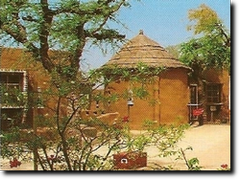
Pokhara – Butterfly guest house
p.m. : I'm in bed and dozing, to recover a bit from yesterday's walk to Mahendra Gufa. All of a sudden there are doors being slammed, enough to make the whole house shake, shouts, dreadful insults, things hurled out of first floor windows into the courtyard below [my room is on the ground floor]. What on earth's happening? I get up and go out to see: the couple from Como are having a bit of a squabble. Strong insults are being hurled by both parties, she's trying to shut him out of the room, he's determined to knock the door down. As is typical in Nepal, within five minutes there are a few hundred curious people standing around, entertained by this unexpected spectacle. Govindan, the owner of the guest house is green, both because he fears for the damage to building and furnishings, and because of the talk this will cause. Anyone who has never been to Nepal can have no idea what it means in this country 'to poke your nose into other people's business'. Suffice to say that when that same afternoon I decided to go for a walk in the town to get away from the disgrace of the scene back at the guest house, dozens of people I'd never seen before and didn't know stopped me to ask what had happened that afternoon at the Butterfly guest house.
When I returned that evening the storm had died down. Balance of damage: her passport ripped to pieces, his glasses smashed to smithereens. These were the less easily repairable damages, then there was more. They have been given separate rooms, seeing that they wouldn't hear of accepting Govindan's invitation to pack up and leave. The best of it is that two days later they were once more in love and accord!
- - - - - - - - - - - - - - - - - - - - - - - - - - - - - -
In the guest house next to mine there's an Afghan who's blonde and blue-eyed. He has great plans for the future, he wants to become a South-East Asia correspondent for some important German newspaper. At present he's living with his mother, who's separated from her husband, in Germany. He's well-informed and he doesn't seem to me to be a boaster. But he's over-fond of spending his evenings smoking hashish until late and then not getting up next morning till midday. The day I left Pokhara, he was to have caught the same bus to Katmandu but, as usual, he overslept and missed the bus. He can't be lacking money if he's able to squander it in such a way. The bus fare to Katmandu is 100 rupees!
In a guest house some distance from the town, in a really beautiful location by a lake, very inexpensive, but with the drawback of having the guest rooms on the ground floor,
directly under those occupied by dozens of hens, there's an English couple from Devon. They are in a bad way, their clothes are quite dirty. At home, they tell me, they live in a caravan, parked in the country. They wash in the stream and use candles for light. Here, to save the rupees a guest house costs they are looking for a cabin to rent from a Gurung [one of the thirty Nepalese ethnic groups], over on the other side of the lake.