L'Arte di Viaggiare - Art of Travel - Francis Galton
8 July Swayambhunath
Namaste Nepal En
Today is the turn of Swayambu, the other large stupa near Kathmandu. It is 20 minutes by foot from Thamel. I saw it shining from on high above the green wooded hill on which it stands. The oldest in Nepal, it is the stupa of Adhi Buddha, the original Buddha, who appeared here in a lotus flame. According to mythology, the temple was built to guard and protect the place where a small flame still burns. Its foundations date back to 2500 years ago, although its present form is from the fourteenth century.
The small sanctuary and the major part of the construction that crowns the hill were built between the 17th and 18th centuries.
The steep stairs of the last section arrive right in front of the giant vajra, the thunderbolt of Indra and a Buddhist symbol of indestructible power. It is placed on a stone pedestal with twelve carved animals that represent the twelve months of the Tibetan year. The terrace is covered with small votive temples, a pagoda and numerous statues, however, the large stupa covers the major part. A colossal statue of the Buddha marks the entrance.
Constructed from a dome of earth and bricks, the temple is crowned with a cube. Painted on the four bronze sides in red, white and black are the compassionate eyes of the Buddha, the third eye of wisdom and a nose in the form of the number one, the symbol of unity.
On each cardinal point there are the four niches of the Dhyani Buddha in meditation. The whole structure of the temple follows precise symbolic rules. Even here there is a line of prayer wheels and hundreds of votive lamps that consume hundreds of kilos of butter per day. There are also Hindu symbols in what is essentially a Buddhist complex. It is the first time I have seen this cultural mixture but I realise that there is more to come.
It is early and there are no tourists, the atmosphere is beautiful! There are men and women bringing their morning offerings and praying. They have come to ask a priest to celebrate the Puja. He is sitting on the floor in front of one of the lateral temples, equipped with rice, flowers, incense and a mysterious powder.....all the paraphernalia necessary for this occasion.
There is a man who is spraying saffron on the small Chaitya. His t-shirt reads “EAT DESSERT FIRST, LIFE IS UNCERTAIN!” a materialist phrase yet one of the most spiritual of actions!
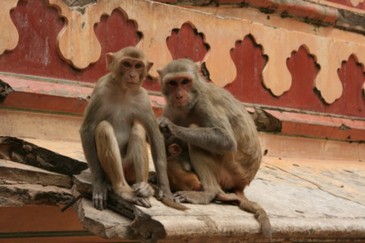
Whilst I sit on the parapet enjoying the sunandthe panorama, one of the hundreds of monkeys that live here moves up to me without my noticing. I jump back afraid he might bite me. I have read that many of these monkeys are infected with rabies, something that will later be confirmed by a German Scientist, who is in Nepal to study their behaviour. He explained that the monkey attacked me because it had been provoked or badly treated in the past by someone else and had therefore become aggressive to all human beings.
Returning from the stupa I am joined by two ‘well to do’ Milanese with a Nepalese guide. We take a short cut by crossing a wobbly bridge over the Vishnumati River whilst below us there are children and pigs splashing about in the mud. After I leave them I am approached by a foreigner asking me for information. She is Italian and a sannyasin follower of Rajneesh. With a strong sing song Venetian accent she explains why she had decided some years ago to follow this guru and how happy she was with her choice. She is here to get her tourist visa. When we part I say that we would probably meet again, Katmandhu is small, Thamel is smaller.
“If our karma permits it...” she replies.
Karma did not permit it; I never saw her again.