L'Arte di Viaggiare - Art of Travel - Francis Galton
22 August Foreign aid
Namaste Nepal En
One of the nice things about waking in the morning, something which only happens to me when I'm on holiday, is to find some song going round in my head, a tune that somehow has surfaced in my mind by who knows what interior route. This morning it's the turn of 'As Time Goes By'. Could the reason be not psychoanalytical at all but rather to be found in the fact that yesterday I saw a Nepalese bunged into the film 'Casablanca' as Humphrey Bogart?
I get up humming this wonderful tune to myself. It's a quarter to five, it's cold, outside it's pouring with rain. I walk round the hotel, everyone's still sleeping. I need the toilet, but the one on my floor is out of use because it's being restructured. I go up to the next floor, but between the corridor and the toilets there's a room which is occupied by the Nepalese and they are still sleeping. Down in reception they have told me to have no scruples about waking them, but I don't dare. I'd love to go and have a cup of tea to warm me, but first I need a toilet.
Eventually the people in the room wake and get up, so I can at last use the bathroom, and then I make a beeline for the tea shop. The bus station is livelier than ever. This is the time when the drivers of the various departing buses give vent to their wildest passion: that of stepping hard on the accelerator to make the engine run as fast as possible, sending out clouds of fumes and a deafening noise. To escape this kind of torture, I think I'll make the most of my free time this morning [this afternoon I'm going into the Shrinagar Hills with Tokic and Siddharta] to go and see the Cottage Industries. These are part of a foreign aid project and, judging by the placard on the main road advertising them, they are a recent creation.
Coming to see for myself some of these projects of cooperation with developing countries, was one of the motives for my journey in Nepal. Before leaving on this trip I had read several things, one of which was the interesting book by Charlie Pye-Smith 'Travels in Nepal – The Sequestered Kingdom'. Other things I read in the British Library in Katmandu. Discouraging: here are the aims that the first American projects set themselves in the 1950s:
- increased production of food, fibre and housing material [also to have an exportable surplus];
- elimination of disease;
- School for all;
- sufficient roads to move agricultural and industrial products;
- hydro-electricity for enough light and irrigation;
- reforestation;
- landownership to the tiller;
- agricoltural credit system;
- development of sense of unity, of love of liberty, respect of the individual.
One could hardly say that any of these aims have been achieved!
Among the comments made below this list of aims, there is the following: “in a Hindu society not only would life always be as it had been, but any attempt to interfere with the unchanging cycle of life would be sacrilegious”. As the first obstacle to be overcome, that's not bad! I believe this sentence sums up the difficulties for a continually changing culture like ours to relate in a correct and respectful way to an unmoving culture like the Nepalese one. Unfortunately foreign interventions, instead of bearing this situation in mind, have superimposed and also imposed, with the effect of sweeping away their values and obtaining disastrous results. It suffice to say that many of these projects, instead of stimulating activities, have created an economic dependence, getting the local population used to receiving money, without the corresponding work. That is why in another interesting book, 'Foreign Aid and Politics in Nepal' by Eugene Bramer Mihaly, taking stock of foreign intervention, the final summing up is this:
“The impact of foreign aid has probably harmed rather than furthered Nepal's long-range prospects for economic growth and political stability.”
The warehouse, which is the premises of this textile workshop, is surrounded by a garden with shrubs and flowers. I enter the office area only to find the rooms empty, there is no-one about. So I go into the workshop area itself: in the first large room there are two looms covered in cobwebs. In the second room there's a man in a corner who is weaving using a bicycle wheel. Otherwise the place is completely deserted.
I try asking the man some questions, but he does not speak English. After a last look at this dusty dirty room full of cobwebs, I leave.
The absurdity is that all around this monument to waste looms are working fast and furiously: every hole is home to at least one, a small one mounted on a bicycle wheel.
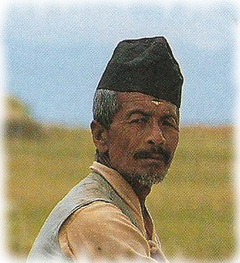
Fabric used to make 'topis', the envelope-shaped Nepalese headgear, is produced here in Tansen.
Why then has the aid project, organised as a cooperative, not worked, while these tiny premises where the people work under an employer are thriving?
I return to the hotel and, all of a sudden, I don't feel at all well. My heart misses beats, my bones feel chilly.
If my final hour has come, I have to say that my timing couldn't be more right. In fact, a funeral is in full swing at the bus station and all that would be needed is a second coffin.
It's a communist funeral, with a great show of red flags. The coffin is hoisted up on to the roof of the bus, the comrades take up their positions behind the bus.
I'm afraid that the deceased might be one of the hunger strikers camped here behind the hotel. I have seen other groups of hunger strikers like this in towns and villages around the country. Hunger strike is the last resort of these civil servants in their protest about 'starvation' wages – what more apt expression - awarded them by the government.
But going back to the funeral: I ask Siddharta for information, could one of the hunger strikers perhaps have died?
“Maybe” he replies, with his usual coolness. And, unruffled, he goes back to eating his roll.
I get into bed, covering myself with the pashmina I've bought and with the filthy quilt. The latter is so smelly that unless I recover quickly from this sudden illness, I shall most probably suffocate. For the moment it dulls my senses and I fall asleep.
I wake again around midday, it's beautifully sunny outside. I get up and go in search of Ante and Siddharta and we set out for the Shrinagar Hills. First, though, Ante wants to drink his usual daily ration of whey.
There's a delightful breeze, which revives me. We sit for a while in the shade of some pine trees. Two Nepalese boys in school uniform come and sit down near us. We start talking and we ask them some questions, but their English is not good at all. They show me their English books and I can see that the texts are geared to people who already have a good knowledge of the language: passages from literature, from social analyses, and from history, followed by very demanding questions to which they also have to give written replies. I ask them who has written the answers and they say that they themselves have done so. I don't believe them: most Nepalese buy second-hand school books and this is the only obvious explanation for the discrepancy between their very scant knowledge of English and the knowledge needed to answer the questions.
We set off again. These hills, once wooded, are now almost completely bare except for some pine woods. Alas, the high rate of demographic growth in Nepal has led to intensive exploitation of all the country's resources, with timber in first place. Unless a reforestation programme on a grand scale is started very soon, in a few years from now the damage will be irreparable.
We go through a tiny village. In one of the houses there's an old lady who is weaving by hand, and also by 'foot' [seeing that she's using the big toe of her right foot to keep the warp taut], those strips that they apply to their baskets in order to carry them 'hung' on their foreheads. I buy two for ten rupees; the colours are magnificent, I shall join them to make a belt.
A bit further on a delicious smell comes wafting through the air: a woman is cooking mushrooms for the family. Scornful of danger, Tokic and I send Siddharta to ask the woman if we can have three small portions. Smiling, she agrees.
I'm increasingly won over by these simple, kind people who greet and satisfy the 'strange' requests of foreigners with a smile. How many of us Italians would do the same towards foreigners?
In spite of their colour, which is that of our poisonous mushrooms, the taste is excellent. And, after so much rice and lentils, I appreciate them even more.
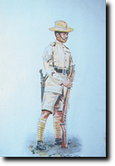
We are about to go on our way, when a Nepalese man with a military step arrives. I get Siddharta to ask him whether he has been in the Gurkhas.
“Yes,” he replies, looking surprised, “how did you guess?”.
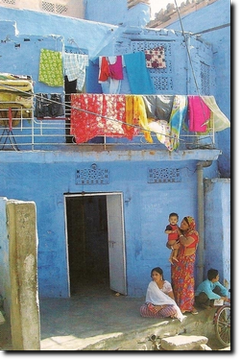
I later discover that he is as drunk as a lord, with 'chang', a fact which,however, does not at all affect his balance in moving and walking over this uneven terrain. Regardless of all the alcohol he has already downed, he asks a woman who runs a sort of tea shop for another glass.
“She ought not to give it to me”, he says looking surreptitiously around, “it's illegal!”. And he makes me promise that I won't say anything about what I've seen to anyone.
I have to admit that I amused myself a bit at this man's expense. Seeing that he was impressed by the fact that I guessed something about his past and because he's not fully with it, I answered his questions paradoxically and deliberately exaggerating things. When he enquired about my age, I told him I was fifty-five. “How can that be possible”, he replied, “if my wife here is only thirty-five and yet she looks much older than you?”.
So then I made him believe that it was thanks to my magic skills that I kept young. In a country like Nepal where magic plays an important part in everyday life, it's relatively easy to make people believe such a thing.
“Why then don't you use your magic art on my wife and rejuvenate her a bit?”, he asks. “My magic powers have very definite territorial limits, unfortunately”, I reply, “the good spirits that help me lose their power once they go outside the borders of my own country.”
A large group of Nepalese, men and women, laden like mules with sacks of rice and salt come into sight. We decide to go along with them as we are headed in the same direction. When they are obliged to stop, exhausted, needing to catch their breath, they look us in the eyes and their features, drawn by the effort, relax into a marvellous smile, almost as if apologising for their limitations.
We've been walking for three hours now and we decide to turn back. I stop to photograph some lovely sculpted stone graves in Anglo-Saxon style. A cemetery for foreigners or for rich Nepalese with a craze for things Western?
In Tansen, Tokic goes to collect a huge Croatian flag; one he ordered from a studio of local artists. He intends to use it for the photos he will have taken at the various stops he'll be making on his journey around the world.