L'Arte di Viaggiare - Art of Travel - Francis Galton
16 July On the way to Janakpur
Namaste Nepal En
I confess I was rather hesitant about travelling to Janakpur. Doubts based on the fact it being the monsoon season the condition of the roads is scary.
Janakpur is about 200km as the crow flies south east of Kathmandu, but to get there you have to cross half of Nepal. First you take the road to Pokhara to the west, then half way you change direction south to Terai, then you go east – a total journey of 12 hours. On the other hand, I do want to see a bit of the Nepalese plains – this is what tips the balance.
I find myself at the bus station at six in the morning even though the time on the ticket that I bought yesterday says 6.30. At 7 there is still no sign of the bus. We leave at 7.30 at speed. Maybe a tentative attempt to make up the lost hour?
Unfortunately we don’t get far – two hours later the bus breaks down and there is no hope of repairing it. After half an hour, the bus which was scheduled to leave Katmandu at 7 arrives.
I’m brought down to earth by the prospect of getting on this second bus. Buses in Nepal already travel packed to the gunnels without having to double the number of passengers. Besides there is still about 10 hours journey ahead of us and there is the unattractive idea of standing with my head bent because the roof of the bus is too low to allow me to stand straight, shaken by the continuous bumps from the uneven road surface and crushed by the crowd.
Luckily my ticket from the broken down bus helps me to push my way through the crowd and to convince two Nepalese to share their seat with me. Since the seats in Nepalese buses are very small (their size!), I'm hanging off the edge of the seat, but it's always better than standing.
And what does it matter being uncomfortable, when you find yourself among people who are continuously showing their generosity and solidarity? It's for this reason that I come to countries like this one - to rediscover these characteristics that no longer exists in our society - and I couldn't care less about the discomfort, the hard life and food that is always the same.
I try to look out of the window but I don't see much. It's still pouring down and our progress is very slow through mud half a metre deep. We pass a very long column of soldiers marching, they do look miserable! There are road works along the whole of the road and we proceed at a snail's pace; we often have to stop to let the oncoming construction lorries pass. Watching these road works it reminds me of the toils of Sisyphus, from classical legend. During the night, the monsoon rains destroy all the progress that has been made during the day.
All the work is carried out by hand; axes, clubs, spades, picks, … they work in tandem with the spades; the man sinks the spade into the ground and the woman pulls the rope tied to the base of the handle to help him lift the weight of earth.
The road follows the Trisuli river where you can go rafting. I see groups of tourists with expensive equipment and ragged Nepalese who look after them in their role of 'factotum', (servant).
We stop at Mugling to eat. There are a dozen restaurants in the square and it is immediately obvious which ones are for 'local people' and which ones for tourists. Quite simply the latter ones have a certain 'kitch' air about them that is often the case with these kind of places for foreigners in poor counties when there hasn't been much capital invested.
As the bus that I am on isn't a tourist one but a normal service bus, with me being the only stranger, the driver directs us to one of the restaurants 'for locals'. Who knows what his commission is for bringing passengers here, be it a free meal or something more?
I don't eat; not because I don't trust the food as is the case with lots of tourists in countries like this where hygiene isn't exactly first rate and they find everything disgusting, but because I never eat when I'm travelling. As the stop is going to be for half an hour I go for a walk around the town.
It's also due to the rain and the mud, but what squalor!
In front of a shack I see a hen and a cockerel with their feet tied together. The cockerel wants to go one way and the hen the other and they both tug at each other trying to free themselves from the knot that keeps them tied up. To me the animals symbolise marriage.
A little further on, there is a pond with lots of geese swimming happily around. Their master arrives and calls to them. Flapping contentedly the geese assemble in single file and swim quickly towards him. Then they swiftly get out of the water, still in single file, and follow their master.
I go back to the square. Everyone has finished eating and so we get back on the bus and leave.
7pm Janakpur
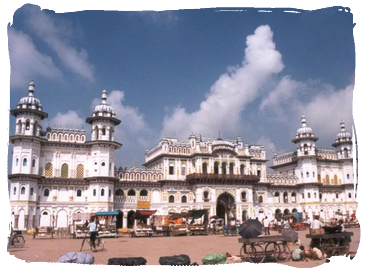
I love travelling alone but there are times when my enthusiasm wanes. I had read in the guide that Janakpur is 'Indian in every respect except politically,' but the looks and comments that I get between the bus station and my hotel give me a sense of unease and oppression. In Nepal it's not normally like this.
Even the Welcome hotel suggested in the guide is Indian. It belongs to an Indian who lives a long way away, it was built by Indians, it is run by Indians and is full of Indians…
Already from the lobby on the ground floor there is a smell of urine that takes your breath away. I go up the stairs littered with every imaginable sort of rubbish and what with the encrusted walls and the dim light bulbs there is a nightmarish atmosphere.
They show me a few rooms: small, suffocating, with small high windows which resemble a medieval prison cell. I don't suffer from claustrophobia but there is no way I'm going to be able to spend the night in a place like this.
And the prices too! Much more expensive than those indicated in the guide. In the end they show me the suite on the top floor for which they are asking an exorbitant price of 350 rupees. I'll describe it: on the floor there are the remains of what was once linoleum, curling and bubbling and somewhat of a trap for the unfortunate occupant of the room; the furniture comprised of a small rickety table, a small fake leather sofa with sagging seats and springs sticking out, two beds with dirty sheets and finally the walls and ceiling as stained and encrusted as the stairway.
In the bathroom there are large brown marks everywhere; on the white wall tiles, on the bath tub and on the toilet, caused by the brown liquid which they call water. Beetles as big as walnuts appear and disappear through holes. I turn on the tap and then the shower and the same brown liquid that I see everywhere comes out. They say that there is a 'shortage of water' - the water that is coming out of the tap must be from the depths of the water tank - so why waste it in the bathroom? And a… 'shortage of water' in the wet season? But what if it's tipping it down outside!
I go down to reception to ask for a hand towel so I can clean my hands after having got them dirty from the water but they give me one that is so dirty that I don't have the courage to use it. As there is a restaurant I order a pot of tea without milk and sugar. They bring me a glass of extremely sweet and milky tea that they have bought from one of the street tea sellers, reselling it to me for 5 times the price. Seeing as I can't be bothered to make a fuss, I decide that from now on I won't ask for anything else - I'll pay the price asked for the room even if I think it is overpriced and I'll go back to Katmandu tomorrow, although I had planned to stay a bit longer.
I go to bed with a certain sense of anguish; I hope that the drunken Indians who I had seen earlier drifting around on the terrace outside my room won't be bothering me tonight. So that I don't hear the brawl anymore I decide to use earplugs.