L'Arte di Viaggiare - Art of Travel - Francis Galton
13 July Cycle ride
Namaste Nepal En
It's Saturday and therefore a rest day. At first it is difficult to think of Saturday as a non working day but then it just becomes a habit. After a breakfast based on tea and bananas at 7.30 we leave.
Nima is the guide on this bicycle adventure. We start vigorously because I hope to escape the traffic before it becomes too busy. This strategy is hopeless, however, because scarsely two kilometers into the journey there is a shattering explosion. A rear tyre has exploded! We return to the bike shop on foot to exchange the bike for another and set out again.
Stage one, Patan. At the Golden Temple I chat with the caretaker who also makes bronze Buddhas. He has been to Turin for business and is keen to recite all the places such as Porta Nuova, Porta Susa, Via Roma, Via Cernaia etc.
After this we head in the direction of Kirtipur, the city of the cut noses, but not before stopping to admire the Chobar Gorge on the way.
"Nestled on a hill 5km south west of Katmandhu, the medieval Newari fortress of Kirtipur was constructed by King Sada Siva Deva in the 12th Century. It was the stronghold that ruled over Gorkha. Pritvi Narayan Shah needed to attack this fortress in order to enter the valley and take the capital of the Malla kingdom. He besieged the fortress 3 times and it was only in 1768 that he finally succeeded. To vindicate his losses during these sieges he cut off the noses and lips of all the male occupants except one. This was because of his love of music and the lucky one knew how to play a wind instrument. The evident signs of decay in the city are not linked entirely to this ancient defeat and its definitive eclipse as a flourishing and independent city, but also to the disastrous earthquake that occurred in 1934. Today Kirtipur appears as a neglected and melancholic city in a state of disrepair, its temples and beautiful houses with their triple wooden carved windows all in ruins.
During the day it is inhabited mainly by the old and children whilst the men and women are working in the fields or employed in traditional fabric making. In comparison with other places in the valley, however, it is more interesting because it has suffered less from tourism. Sitting in the shade along one of the dusty strips of road you can observe the life of a Newary town that has followed the same rhythm for centuries."
After drinking a couple of sweet warm Fantas purchased from a shop located right in front of the temple of Bagh Bairav, the tiger god, one of the manifestations of Shiva, we climb to the pagoda dedicated to Uma and Maheshwar, the divine couple of Shiva and Parvati.
From here we admire the paddy fields spread out below us and Nima points out the peak of Langtang, where we will be going in a few days as guests of his relatives and of Gosainkund. Since his knowledge of architecture is no better than his knowledge of the mountains I take the lead and read:
"According to legend the temple of Hagh Bhairav was built in the 16th Century in the place where shepherds had jokingly moulded a clay tiger and later found it alive and with a full stomach due to it being on the sheep path. The temple is a pagoda built with four floors and three roofs supported by carved struts. From the central roof are hung shields, weapons and tools collected after the attack of Prithvi Narayan Shah on the fortress and offered to the gods by the devout. On the external walls of the ground floor there are some interesting frescos that show scenes from the Mahabharata in the late Malla style from the 16th century. They were however in a deplorable condition.
The Torana (a gateway) carved over the main entrance shows Vishnu riding Garuda and underneath it, Bhairav flanked by Ganesh and Kumar, the god of war".
Earlier, whilst we were at Chobar Gorge, Nima had suggested going to Daksinkhali but I had refused. The idea of pedaling 20km uphill in this humidity whilst inhaling the exhaust fumes of the numerous buses carrying locals up to sacrifice goats and chickens did not appeal. However, since I feel full of energy and at this time of day I hope that the devout have all finished we return to the point where we had been this morning.
Whilst changing gear on my ancient mountain bike, (made in Taiwan) the chain comes off. My companion in misfortune fixes it and adjusts my gear mechanism in an instant. Now all I need is a puncture. Am I jinxed today?
The temple is located on the confluence of two rivers amongst the trees. It was built in the 17th century by Pratap Malla and is dedicated to the god Kali, here shown with 6 arms in the act of trampling Vetala with Ganesh.
It is on this black stone sculpture that the blood of sacrificed animals is sprayed. The sacrificial animals are chickens, geese, goats, sheep and pigs. These animals must be ungelded males and dark in colour.
After the rite of sacrifice the animals are returned to their owners who, after plucking or skinning them, hand them back to be cut up by the butchers who are there for that reason, put them in pans of boiling water and they are then eaten in situ. In fact, when we arrive we pass a family group of twenty or so who have with them a gas stove with a cylinder. The women are carrying large saucepans balanced precariously on their heads. In the meantime I wipe the sweat from my face and cleaning off some of the soot accumulated during the trip, I am bathed in the delicious perfume of the last sacrificial victim being cooked. If only someone would invite me to lunch!
But as no one picks up my unspoken wish, we sit in one of the tea-shops lining the road that climbs to the temple. A glass of milky tea, sweet and hot, is not exactly what I want at the moment. (I have tried a few times to ask for tea without sugar but they always look at me strangely!)
After having seen the slaughter of a dozen or so chickens and goats we leave at full speed down the mountain. I know that this will cost me at least a sore throat, but the pleasure of fresh air on my skin is too good to miss!
Before arriving back at Kathmandu we take a turning to the right onto a dirt track that takes us towards a pretty village in the middle of brilliant green paddy fields. Soon, however, the road becomes impassable and we have to push our bikes. Even though we are only a few kilometres away from Kathmandu it seems light years away. Men and women are working in the fields, children running around and the oldies are playing Karen board in the shade of an ancient tree whilst a body is being burned on a pyre. All is quiet whilst life follows the rhythm of centuries, but for how much longer?
After passing through a wood we suddenly come out onto a tarmac road. We climb back on our bikes and head for Bodnath, our last destination for today.
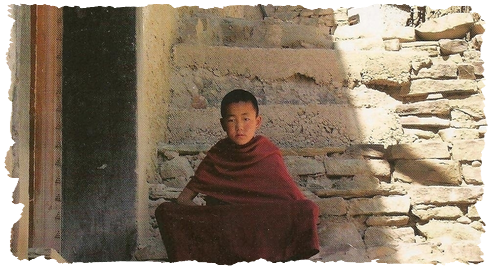
We leave our bikes to visit one of the many monasteries that we find around the stupa. A group of child monks chant verses from a long narrow book that they unfold from the bottom to the top. Every now and again the sound of a horn cuts through the chanting. A monk passes and pours water over the heads of the boys, who try to move away and laugh.
We leave and head towards the temple; full of colour and like all Buddhist temples, contains a gigantic statue of Buddha. On our way out a palm reader offers to read my palm. I indicate that I am interested but do not have any money with me. He says he cannot read my palm without payment as this would bring bad luck. For me or more so for him?